Friday, September 02, 2016

Taco Trucks on Every Corner’: Trump Supporter’s Anti-Immigration Warning

Photo
A video image of Marco Gutierrez, founder of Latinos for Trump, during his interview on MSNBC on Thursday. CreditMsnbc
“My culture is a very dominant culture, and it’s imposing and it’s causing problems. If you don’t do something about it, you’re going to have taco trucks on every corner.”
That was Marco Gutierrez, founder of the group Latinos for Trump, issuing a dire warning to the United States in an interview with Joy Reid on MSNBC on Thursday night.
America’s response? Mmm, tacos!
Though some sympathized with the message, Mr. Gutierrez’s comments elicited a largely sarcastic backlash on social media. #TacosOnEveryCorner surged to the top of Twitter’s list of trending topics, where it remained on Friday morning.
The comment came at a sensitive time for Donald J. Trump’s presidential campaign. Several members of his Hispanic advisory council withdrew their support this week, saying they had been led to believe that Mr. Trump was shifting his hard-line tone on immigration.
“He used us as props,” said Jacob Monty, who resigned after Mr. Trump reverted to his fiery language on immigration Wednesday night after returning from Mexico, where he had struck a more measured, even subdued, tone.
During the interview with Mr. Gutierrez, Ms. Reid quickly interjected, saying, “I don’t even know what that means, and I’m almost afraid to ask.”
Mr. Gutierrez explained:
“We are a culture that — we have a lot of good things that we bring to the United States, but we also have problems.”
Mr. Gutierrez might have spared himself some of the ridicule had he recognized America’s longstanding love affair with Mexican food. Nearly 25 years ago, salsa surpassed ketchup in retail store sales, and some would argue that Mexican food has already conquered American cuisine.

Get the Morning Briefing by Email

What you need to know to start your day, delivered to your inbox. Monday – Friday.
Mr. Trump, for his part, has long been accused of being tone-deaf in his Hispanic outreach, including, for example, in his posting of a photo of himself and a taco bowl on May 5, proclaiming, “I love Hispanics!”
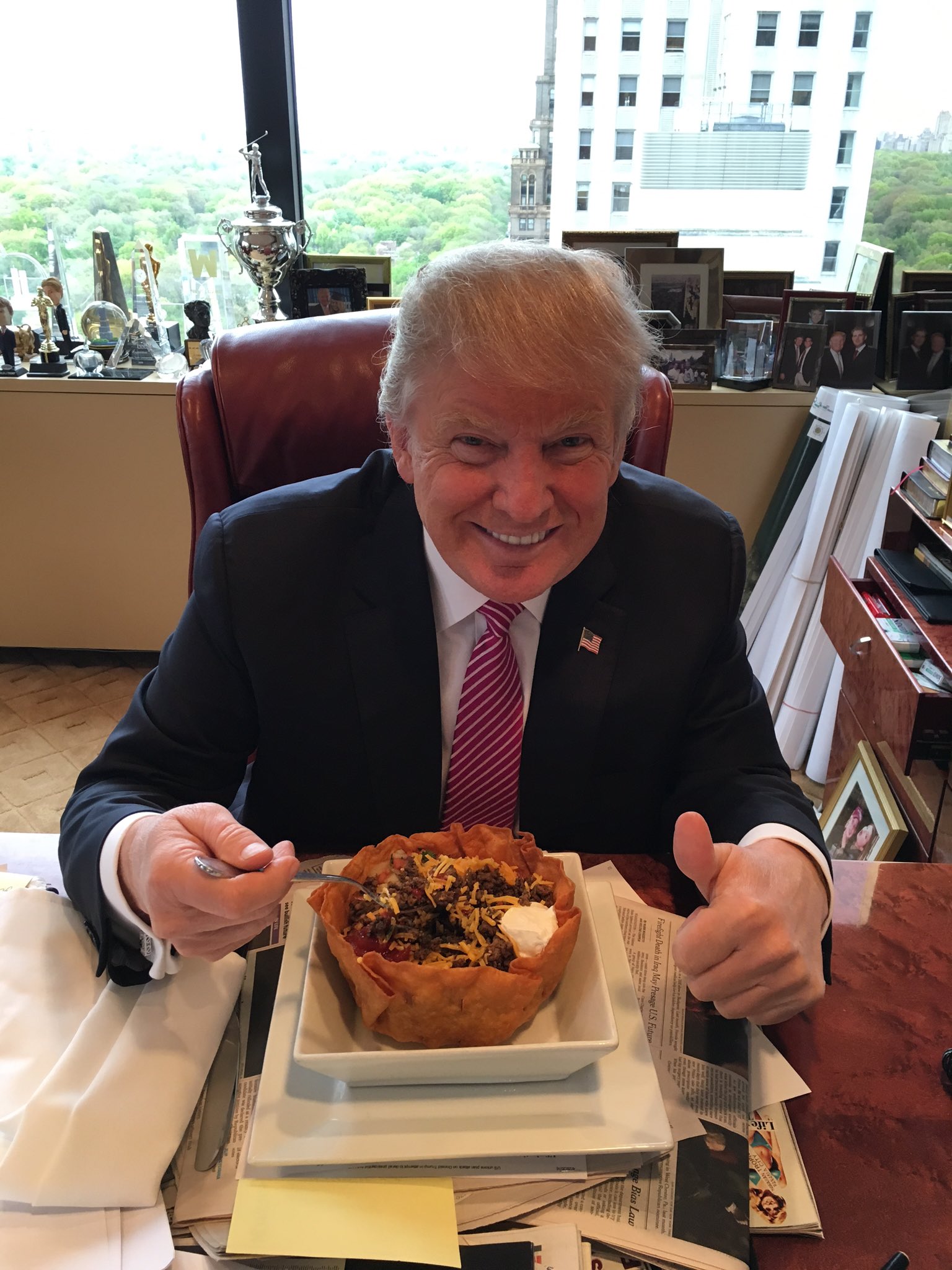
From the start, his hard-line approach to immigration has alienated Hispanics, and his accusation that Mexico was sending rapists across the border did nothing to tame the controversy.
“When Mexico sends its people, they’re not sending their best,” Mr. Trump said in announcing his campaign in June 2015. “They’re not sending you. They’re not sending you. They’re sending people that have lots of problems, and they’re bringing those problems with us. They’re bringing drugs. They’re bringing crime. They’re rapists. And some, I assume, are good people.”
Later that day, he added that, to keep out undocumented immigrants, he would “build a great wall, and nobody builds walls better than me,” a promise repeated numerous times since, including in Phoenix on Wednesday.
As a Trump surrogate, Mr. Gutierrez is not the first to offend. The African-American pastor Mark Burns has said that Hillary Clinton, the Democratic nominee, panders to African-Americans and endorses black genocide. He also apologized for retweeting images of Mrs. Clinton in blackface.
Some observers saw the taco truck remarks as code words to mine the racial resentments of white Americans.
Others reacted with humor:

Black Lead Matters

Photo
Residents of the West Calumet Housing Complex, where the soil is contaminated with staggering levels of lead. CreditAlyssa Schukar for The New York Times
Donald Trump is still claiming that “inner-city crime is reaching record levels,” promising to save African-Americans from the “slaughter.” In fact, this urban apocalypse is a figment of his imagination; urban crime is actually at historically low levels. But he’s not the kind of guy to care about another “Pants on Fire” verdict from PolitiFact.
Yet some things are, of course, far from fine in our cities, and there is a lot we should be doing to help black communities. We could, for example, stop pumping lead into their children’s blood.
You may think that I’m talking about the water crisis in Flint, Mich., which justifiably caused national outrage early this year, only to fade from the headlines. But Flint was just an extreme example of a much bigger problem. And it’s a problem that should be part of our political debate: Like it or not, poisoning kids is a partisan issue.
To be sure, there’s a lot less lead poisoning in today’s America than there was back in what Trump supporters regard as the good old days. Indeed, some analysts believe that declining lead pollution has been an important factor in declining crime.
But I’ve just been reading a new study by a team of economists and health experts confirming the growing consensus that even low levels of lead in children’s bloodstreams have significant adverse effects on cognitive performance. And lead exposure is still strongly correlated with growing up in a disadvantaged household.
But how can this be going on in a country that claims to believe in equality of opportunity? Just in case it’s not obvious: Children who are being poisoned by their environment don’t have the same opportunities as children who aren’t.
For a longer perspective I’ve been reading the 2013 book “Lead Wars: The Politics of Science and Fate of America’s Children.” The tale the book tells is not, to be honest, all that surprising. But it’s still depressing. For we’ve known about the harm lead does for generations; yet action came slowly, and remains highly incomplete even today.

Sign Up for the Opinion Today Newsletter

Every weekday, get thought-provoking commentary from Op-Ed columnists, The Times editorial board and contributing writers from around the world.
You can guess how it went. The lead industry didn’t want to see its business cramped by pesky regulations, so it belittled the science while vastly exaggerating the cost of protecting the public — a strategy all too familiar to anyone who has followed debates from acid rain to ozone to climate change.
In the case of lead, however, there was an additional element of blaming the victims: asserting that lead poisoning was only a problem among ignorant “Negro and Puerto Rican families” who didn’t fix up their dwellings and take care of their children.
This strategy succeeded in delaying action for decades — decades that left a literally toxic legacy in the form of millions of homes and apartments slathered in lead paint.
Lead paint was finally taken off the market in 1978, but then ideology stepped in. The Reagan administration insisted that government was always the problem, never the solution — and if science pointed to problems that needed a government solution, it was time to deny the science and bully the scientists, or at least make sure that panels helping set official policy were stuffed with industry-friendly flacks. The administration of George W. Bush did the same thing.
Which brings us back to the current political scene. What with everything else filling the airwaves, it may be hard to focus on lead poisoning, or environmental issues in general. But there’s a huge difference between the candidates, and the parties, on such issues. And it’s a difference that will matter whatever happens to Congress: A lot of environmental policy consists in deciding how to apply existing laws, so that if Hillary Clinton becomes president, she can have substantial influence even if she faces obstruction from a Republican Congress.
And the partisan divide is exactly what you would expect.
Mrs. Clinton has pledged to “remove lead from everywhere” within five years. She probably wouldn’t be able to get Congress to pay for that ambitious an agenda, but everything in her history, especially her decades-long focus on family policy, suggests that she would make a serious effort.
On the other side, Mr. Trump — oh, never mind. He rants against government regulations of all kinds, and you can imagine what his real estate friends would think about being forced to get the remaining lead out of their buildings. Now, maybe he could be persuaded by scientific evidence to do the right thing. Also, maybe he could be convinced to become a Buddhist monk, which seems about equally likely.
The point is that the divide over lead should be seen not just as important in itself but as an indicator of the broader stakes. If you believe that science should inform policy and that children should be protected from poison, well, that’s a partisan position.

Black Lead Matters - The New York Times

Black Lead Matters - The New York Times:


"Donald Trump is still claiming that “inner-city crime is reaching record levels,” promising to save African-Americans from the “slaughter.” In fact, this urban apocalypse is a figment of his imagination; urban crime is actually at historically low levels. But he’s not the kind of guy to care about another “Pants on Fire” verdict from PolitiFact."


'via Blog this'

Thursday, September 01, 2016

Why Did Peña Nieto Invite Trump to Mexico?

Mexico City — Mexico’s president, Enrique Peña Nieto, had already had a terrible summer. July was the most murderous month in Mexico since he took office in 2012. Second-quarter results showed negative economic growth for the first time in three years. A survey found his approval rating slipping to 23 percent. And a news report even alleged that he plagiarized nearly a third of his law degree thesis. How could he make it any worse? Only by inviting Donald J. Trump, one of the most hated men in Mexico — so hated that piñatas with his visage are brisk sellers across the country — to his presidential palace.
The curious thing about Mr. Peña Nieto’s latest debacle is how, unlike his other woes, it was totally self-inflicted. There is little tradition of sitting Mexican leaders meeting with American presidential hopefuls, so he was under no pressure to arrange the get-together. And it couldn’t have come at a worse time: the very day of Mr. Trump’s hard-hitting immigration speech, and the day before Mr. Peña Nieto’s state of the union address. Mr. Peña Nieto had even compared Mr. Trump to Hitler.
But in a stupefying decision, last week he sent invitations out to the Democratic hopeful Hillary Clinton and Mr. Trump to come to Mexico, and then conceded, reportedly under pressure from the Trump team, to meet its candidate first, on the fateful Aug. 31.
Photo
Protests against the meeting between Donald Trump and Enrique Peña Nieto, in Mexico.CreditAdriana Zehbrauskas for The New York Times
Mr. Peña Nieto insists that his nation won something from the encounter. “I was very clear — in public and private — in emphasizing that in Mexico we feel wounded and hurt by his announcements about Mexicans,” he wrote in an opinion piece in El Universal newspaper on Thursday. “I expressed that Mexicans deserve respect.”
But most politicians and pundits — and the public — read the scene differently. To them, Mr. Peña Nieto looked weak and submissive in front of a bully who is humiliating their nation. Certainly he lost the opportunity, in his own palace, and as a president to a mere candidate, to state clearly that his country would never pay for a border wall in the United States. His later tweet that he warned Mr. Trump is weak tea, a diplomatic “he said, she said.”
Mr. Trump’s staff claimed meanwhile that he looked presidential and firm in a difficult foreign country — and may have won points with Mexican-American voters. Indeed, Mr. Peña Nieto had been a useful pawn in Mr. Trump’s election campaign. Just consider Mr. Trump’s Arizona immigration speech just hours after the meeting, when the candidate repeated his mantra, “We will build a great wall along the southern border,” and then left a dramatic pause before digging the knife in with, “and Mexico will pay for the wall. One hundred percent.” The Mexican president had failed to move Mr. Trump’s position one iota.
The debacle seems so predictable that it’s hard not to imagine that Mr. Peña Nieto’s advisers deliberately led him to error, in a “House of Cards”-style plot. But the truth is likely one that is harder for Mr. Peña Nieto to find a quick fix for. His problems, including the Trump caper, reflect how ill-suited he is to govern a major country like Mexico.

Sign Up for the Opinion Today Newsletter

Every weekday, get thought-provoking commentary from Op-Ed columnists, The Times editorial board and contributing writers from around the world.
The president’s Institutional Revolutionary Party, or P.R.I., ruled Mexico for 71 straight years until 2000, through an all-encompassing political machine that the writer Mario Vargas Llosa called “the perfect dictatorship.” Mr. Peña Nieto won back power for his party after 12 years in the wilderness with the promise that it had changed into a dynamic, democratic party that would modernize Mexico. And he was its telegenic leader, with a soap opera star for a first lady. After he won office, newspapers predicted a forthcoming “Mexican miracle.”
But it gradually became apparent that Mr. Peña Nieto and his P.R.I. team were more of the same, representing entrenched interests and out of sync with much of their country. After cartel gunmen and police officers kidnapped 43 student teachers in 2014, the government failed to carry out a satisfactory investigation into the corrupt security forces, despite major protests. That same year it was revealed that Mr. Peña Nieto’s wife was buying a $7 million mansion from a company that received government contracts. He apologized, and his wife gave the house back, but P.R.I. politicians have resisted effective anticorruption laws, defying the popular mood.
The Trump meeting is just par for the course, showing how out of touch he is with his country and the millions of Mexicans living in the United States. Surveys here show an enormous rejection of the Republican candidate; one, by the newspaper Reforma, found that only 3 percent of Mexicans would like to see Mr. Trump as America’s president.
So what was he thinking? Maybe Mr. Peña Nieto gambled that he could change Mr. Trump’s position, and lost. Maybe his low approval ratings sapped his confidence to publicly confront Mr. Trump about the border wall. Maybe he thought he could divert attention from his domestic troubles.
Whatever his motives, the Trump encounter only dug a deeper hole for Mr. Peña Nieto, who will rule until 2018. The future will show whether his approval ratings tumble even further and how difficult his last two years of his government will be — in a country that desperately needs smart leadership.

Mental Geography

Oregonians searching for gold killed American Indians in the middle of the nineteenth century.

Recently the UCLA historian Benjamin Madley published a book on an anthropological topic, which you can read about at the website of Cabrillo College here.

The Amazon link to the book is :

Amazon

The Republican Presidential candidate went to Mexico yesterday, but he did not learn these facts, or others which are documented in many sources, so I write these ideas to help those who do want to know about the conflicted relationship between Mexico and the US.

Besides the real geography, which I define here as the physical description of the surface of the planet we inhabit, there is a more important, and less understood Mental Geography. Our mental map of lands and people is a mere approximation of the real one.

If you live in the border, you can just walk to Mexico, nevertheless you may not record some facts on your mental map, which are plainly evident to those with a mind in tune with some aspects of justice.

I witnessed these American mental maps while I was a graduate student in California during a few years of last century, and have plainly witnessed them now during these presidential campaign in the US.

For some Americans, Mexico is a place to separate the US from. Not a place to find help and friendship.

To be fair, some Mexicans do not want to know about the ten million or so Mexicans, who do not speak Spanish, and have lived there for over ten thousand years.

The longer we wait, the real Geography will come to haunt us with a bigger impact.

During these moments of environmental stress, we have to come together to save our planet.

Twitter Updates

Search This Blog

Total Pageviews