Tuesday, September 05, 2017

Pondering Voyagers’ Interstellar Journeys, and Our Own

Photo
CreditRobert Beatty
Tempe, Ariz. — Tuesday is the 40th anniversary of the launch of Voyager 1, which, paradoxically, was shot into space two weeks after its partner spacecraft, Voyager 2. With all of the turbulent terrestrial news of late, it may seem like humanity is stuck in the past, dominated by religious wars and racial violence. But pondering the journey of these two small space explorers reminds us of just how far humanity has traveled in just a few decades.
In 2012, Voyager 1 left the sheltered cocoon we call the heliosphere, a bubble in space in which the pressure from the sun’s wind of particles and its magnetic field overcome the outside pressure from the rarefied gas that permeates the rest of our galaxy. It became the first object built by humans to depart our solar system, to wander through dark interstellar space. (Voyager 2, on a different trajectory, remains within the heliosphere.)
One way or another, humanity’s future is in the cosmos. Perhaps spacecraft will one day manage to carry humans to the stars, or at least robots with instructions on how to create humans.
Or, humanity may never expand beyond Earth. In two billion years, the sun’s brightness will increase by 15 percent, making our home similar to Venus today. A runaway greenhouse effect will produce surface temperatures in excess of 700 degrees Fahrenheit. Following that, in five billion years, the sun will exhaust its hydrogen fuel and its outer surface will expand as it becomes a red giant, eventually encompassing Earth within its outer layers.
As this happens, our atmosphere will be blown out into the cosmos, and the atoms that now make up our bodies may be dispersed into the interstellar medium, perhaps to seed some future planet around some star that has yet to be born.
Continue reading the main story
For humans, these two futures are wildly divergent. But for our atoms, they are largely the same. Many will end up among the stars, whether they travel outward into the cosmos in spacecraft or are propelled by a massive atmospheric shock wave.
All the while, our two Voyager spacecraft are likely to continue their lonely journeys among the stars. Humanity may perish, but somewhere in our galaxy will be evidence that we once existed.
The Voyagers carry with them a much-heralded snapshot in time. The famous and romantic Golden Record, developed by Carl Sagan and his colleagues, with music and images from the world as it was in 1977, might be discovered one day by distant aliens who find the crafts wandering in their vicinity of the galaxy.
The spacecraft themselves provide another important snapshot in time. They are remarkably primitive by today’s standards. The computers governing the onboard systems have less computing power than the small fob I use to remotely unlock my car. Much of the knowledge base and technology, and even some of the global challenges associated with the civilization that created them, is obsolete.
Think of how much our understanding of the universe has changed since 1977. We now know that all the visible stars and galaxies and everything we could then see with our telescopes are actually merely 1 percent of what is actually there. The known universe in 1977 was but the visible part of a cosmic iceberg, the bulk of which is made up of material having no resemblance to the matter that makes us up. Even more inexplicable is the fact that 70 percent of the total energy of the cosmos resides mysteriously in empty space, which is causing the expansion of our universe to speed up, not slow down.
Even in our own solar system, we expected the moons of Jupiter and Saturn were merely dead lumps of rock or frozen snowballs, whereas we now understand that several have warm oceans underneath a coating of ice — ideal potential breeding grounds for what may be independent forms of life.
We also had no direct evidence that any planets existed around other stars. We have now discovered thousands of them, some of which may be habitable, including one around our nearest neighbor, Proxima Centauri. And we know that our solar system is by no means typical.
We have discovered massive black holes at the center of many galaxies and have observed the convulsions of space as black holes collide and merge. On smaller scales, we have unraveled the nature of three of the four fundamental forces of the universe and discovered the Higgs particle, validating our picture of the origin of mass in the cosmos.
On human scales, we have mapped the human genome and can now routinely cut and paste DNA sequences in genes, with many of the science fiction possibilities, good and bad, that such new technology entails. We have developed machines that can learn and that someday may replace humans in much of our work force. And we get our information and communicate using the internet, something that not even science fiction anticipated in 1977. Global warming, ocean acidification and other environmental impacts that will govern life in the 21st century were not on the radar screen for most of us when Voyager 1 launched.
Where will humanity be in another 40 years, as these spacecraft continue their travels, though still closer to their home star than any other? Will we continue our own voyage of discovery? Will we meet the global challenges we face or succumb to them? The future for the Voyager spacecraft may already be written. Our own future remains in our hands.

Monday, September 04, 2017

‘Twin Peaks’ Season 3 Finale: The Curtain Call

Photo


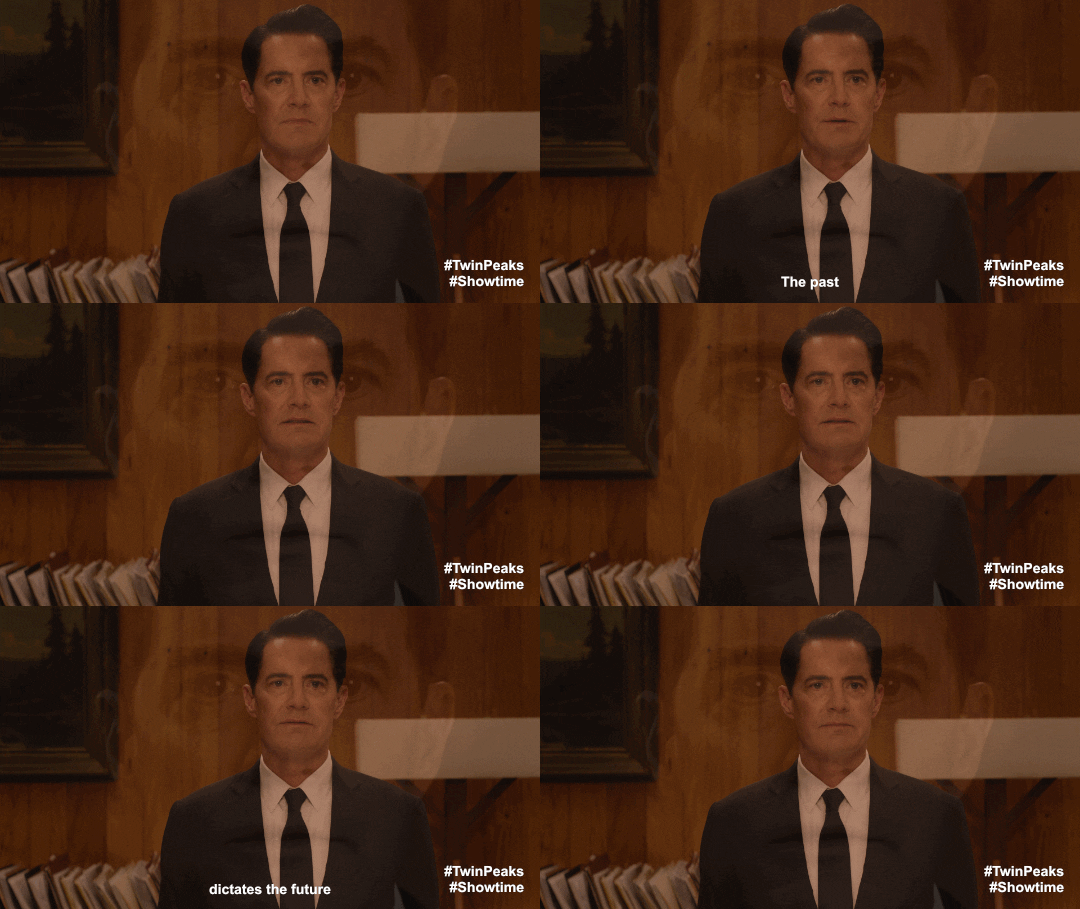
Kyle MacLachlan in the finale of “Twin Peaks: The Return.” Credit Suzanne Tenner/Showtime

Episodes 17 & 18

In May of 1990, ABC aired the “Twin Peaks” Season 1 finale, and frustrated viewers who’d expected the show’s creators David Lynch and Mark Frost to resolve the “Who killed Laura Palmer?” mystery. In June of 1991, “Twin Peaks” Season 2 also ended with more questions than answers, and stuck fans with a cruel twist, revealing that heroic FBI Agent Dale Cooper had been replaced by an evil twin. So if you were confounded by the way the third (and perhaps last-ever) “Twin Peaks” season wrapped up last night ... well, call it tradition. Whether by circumstance or intent, this has always been a TV drama that eschews tidy resolutions.

What makes Season 3’s sucker-punch especially powerful though is that it comes as something of a surprise. For the better part of an hour, the first half of the two-part finale seems poised to put a festive bow on nearly everything that’s come before, pleasing everyone who cheered last week when the ready-to-rock Agent Cooper emerged from a summer-long fog. But everything sours quickly at the end of the episode, and in the following one.

All in all, these were two mesmerizing hours of television, but because they follow Lynch’s usual dream-logic, they’re not always plain about their meaning. Here’s a nutshell interpretation of what they literally depict:

In the first hour, Cooper’s dark doppelgänger Mr. C is finally forced back to the Lodge that spawned him, thanks a combination of Lucy’s deadly marksmanship and Freddie Sykes’s supercharged punching power. Cooper then uses knowledge he’s apparently acquired during decades in limbo to seek a more lasting justice, by jumping back in time to prevent Laura Palmer from being killed. But while he does steer her away from the scene of her murder, the effort ends with Laura disappearing into the darkness, screaming in terror.

In the second hour, Cooper takes off after Laura, journeying with his former colleague Diane Evans (also now back to her real self) through one of the nebulous portals that dot the American landscape. They stop for the night at a motel, and in morning he wakes up to a goodbye note written from “Linda” to “Richard” — suggesting that both he and Diane slipped into new identities after passing through the wormhole. Cooper eventually finds someone in Odessa, Texas who looks like Laura but goes by the name Carrie Page. He tries to bring this woman “home,” but when they get to Twin Peaks they discover the Palmers’ old house is occupied by other people. Carrie becomes as panicked and soul-sick as Laura used to be when she was at that address. She screams again. And so “The Return” ends.

The Best TV Shows and Movies New to Netflix, Amazon and More in September

New movies and TV shows are added to streaming platforms each month. Here are the titles we think are most interesting in September.

I can only guess at what this all means, based on clues dropped throughout “Twin Peaks,” as well as in the prequel film “Fire Walk with Me.” Bear with me while I repeat some of what I think we know.

Gordon Cole explains that the mysterious “Judy” his old partner Phillip Jeffries talked about is an ancient entity, whose name is pronounced “joo-day.” This might be the same malevolence we’ve seen as “Bob,” inhabiting Leland Palmer and Mr. C. If so, he/she/it would be one of an array of otherworldly beings who’ve been exerting a crude influence over humanity, largely via dreams, portents, and doppelgängers. Other shadowy figures have included the Fireman, the Arm and the old lady sometimes called “Mrs. Tremond” or “Mrs. Chalfont”

Photo

Frances Bay as Mrs. Tremond/Chalfont and Jonathan J. Leppell in “Twin Peaks: Fire Walk With Me.” Credit New Line Cinema

Which brings us to the show’s final minutes, where we find out that the Palmer home’s new owner (played by Mary Reber, who actually owns the real property) is named Alice Tremond, and that she bought the house from a Mrs. Chalfont. It’s possible the Palmer house itself is one of these “soft places” around the world, where humans and immortals pass back and forth, leaving scenes of violence and misery in their wake. This would explain why both Laura and Sarah Palmer were frequently plagued with terrifying visions while walking up and down their stairs.
When Cooper and Diane drove past the power line tower, he said things could be different. He pulled into one hotel with an older car, and...

It would also maybe explain why Cooper can’t fix everything by changing the past. We see a repeat of a few key scenes from the “Twin Peaks” pilot, altered so that Laura’s body is no longer “wrapped in plastic” by the lake. But despite these alterations, Laura’s old house still seems possessed by evil spirits, and her parallel universe life as Carrie Page isn’t much better than one she left behind. (In fact, when Cooper/Richard drops by Laura/Carrie’s apartment, there’s a freshly killed man on a chair in her living room.) “What year is it?” Cooper asks at the end, as if that’s going to make a difference — as if some miseries aren’t just threaded into the fabric of whatever universe he lands in.


There’s a lot more to deconstruct here, including multiple moments where characters seem to be waking up to the possibility that they’re actually fictional constructs. Cooper says goodbye to his FBI colleagues with a resolute, “See you at the curtain call,” like they’re all actors, preparing for their final scene. And at one point, he gets jarred out of his gung-ho persona for a second and a still shot of his stunned face remains faintly superimposed over the screen — as though Coop were standing back and watching himself play out a made-up TV story.

Looking for Something to Watch Tonight?


All of this though raises a big question: Was this a satisfying way to end three months of television, with a sprinkling of metafiction and a hefty dollop of existential despair?

Photo

Kyle MacLachlan in “Twin Peaks: The Return.” Credit Showtime

Personally, I loved it. There are plenty of moments in these last two episodes aimed at fans of the show: like Cooper calling the Twin Peaks police station to ask if the coffee’s on, or Lucy shooting Mr. C (then saying, adorably, “I understand cellular phones now!”), or the return of Julee Cruise to the roadhouse stage or the reprise/reimagining of scenes from the pilot and from “Fire Walk with Me.”

The best moments throughout “Twin Peaks: The Return” though could be enjoyed as pure televisual poetry, regardless of their larger meaning. Watching these two hours felt at times like falling into a trance. Lynch employs a lot of his best techniques and motifs: such as making his actors’ movements look unnatural by running the film backward, and “cracking” the image on the screen to reveal something beneath the surface. The branching reality recalls Lynch’s films “Lost Highway” and “Mulholland Dr.,” where characters’ personalities, circumstances, and even names change from scene to scene.

Mostly though, this finale felt like a recalibration. In the recent documentary “David Lynch: The Art Life,” the director tells the story of how he started smoking, drinking and sneaking out at night after his family moved to Virginia when he was a teenager, and admits, “It was almost like I couldn’t control it.”

I thought about that during these last two episodes of “Twin Peaks: The Return,” and especially when the Arm repeated a question that Audrey asked a few weeks back: “Is it the story of the little girl who lived down the lane?” For Lynch, that’s never really been the story. He’s spent much of his life and career preoccupied by the mysteries of compulsion, and fascinated by how there’s only a few degrees of difference between a good person and a bad one.

Like so many longtime “Twin Peaks” fans, Agent Cooper approaches the end of his adventure with the dogged belief that his mission has always been about avenging Laura Palmer, and preventing young women like her from being hurt in the future. But if “The Return” has made anything plain about Lynch and Frost’s vision for “Twin Peaks,” it’s that they see corruption and tragedy as inevitable, regardless of the time, place or generation. They do see the glow within people too, and the bonds we forge. But in a way that just makes the ends we all come to more heartbreaking.

So “satisfying” would be the wrong word to describe any “Twin Peaks” ending. But it’s not all bleak, either. Anyone looking for comfort should just know that at least there’ll always be another Cooper, in another one of his guises, working to see if this time he can make everything turn out all right. He just can’t help himself.

Extra Doughnuts:

• The finale clarifies that the One-Armed Man recreated a version of Dougie to reunite with Sonny Jim and Janey-E. We’re also reassured that Ben Horne has been informed about the whereabouts of his brother Jerry. But what was the deal with Audrey’s freakout at the roadhouse last week? Did Steven Burnett actually shoot himself in the woods? Will Becky be O.K.? We may never know the answers to any of these questions. For those annoyed by the elliptical nature of the finale, I’ll say that while I didn’t share your disgruntlement, I do think you’re probably justified in wondering whether every scene of the past eighteen hours has been “necessary,” per se.

• “David Lynch: The Art Life” will be available on a Criterion Collection Blu-ray on September 26th, and I highly recommended it. There’s a lot there that’ll resonate with “Twin Peaks” fans — including scenes of Lynch swilling wine just like Gordon Cole, and some home movie footage of his mother carrying a log. I’d also suggest that Lynch devotees track down the recent “Blue Velvet Revisted,” which compiles behind-the-scenes footage and interviews from the set of his 1986 movie masterpiece. Both docs are notable for how they reveal Lynch not as some alien weirdo but as a hard-working craftsman, always at his happiest when he’s making something.
NYT

Why Can’t We Get Cities Right?

Photo
The highways in Houston were empty last Tuesday after the city was inundated with floodwaters from Hurricane Harvey. CreditDavid J. Phillip/Associated Press.
The waters are receding in Houston, and so, inevitably, is national interest. But Harvey will leave a huge amount of wreckage behind, some of it invisible. In particular, we don’t yet know just how much poison has been released by flooding of chemical plants, waste dumps, and more. But it’s a good bet that more people will eventually die from the toxins Harvey leaves behind than were killed during the storm itself.
Oh, and if you trust the current administration to handle Harvey’s aftermath right, I’ve got a degree from Trump University you might want to buy. There are already signs of dereliction: Many toxic waste sites are flooded, but the Environmental Protection Agency is conspicuously absent.
Anyway, Harvey was an epic disaster. And it was a disaster brought on, in large part, by bad policy. As many have pointed out, what made Houston so vulnerable to flooding was rampant, unregulated development. Put it this way: Greater Houston still has less than a third as many people as greater New York, but it covers roughly the same area, and probably has a smaller percentage of land that hasn’t been paved or built on.
Houston’s sprawl gave the city terrible traffic and an outsized pollution footprint even before the hurricane. When the rains came, the vast paved-over area meant that rising waters had nowhere to go.
So is Houston’s disaster a lesson in the importance of urban land-use regulation, of not letting developers build whatever they want, wherever they want? Yes, but.
Continue reading the main story
To understand that “but,” consider the different kind of disaster taking place in San Francisco. Where Houston has long been famous for its virtual absence of regulations on building, greater San Francisco is famous for its NIMBYism — that is, the power of “not in my backyard” sentiment to prevent new housing construction. The Bay Area economy has boomed in recent years, mainly thanks to Silicon Valley; but very few new housing units have been added.
The result has been soaring rents and home prices. The median monthly rent on a one-bedroom apartment in San Francisco is more than $3,000, the highest in the nation and roughly triple the rent in Houston; the median price of a single-family home is more than $800,000.
And while geography — the constraint imposed by water and mountains — is often offered as an excuse for the Bay Area’s failure to build more housing, there’s no good reason it couldn’t build up. San Francisco housing is now quite a lot more expensive than New York housing, so why not have more tall buildings?
But politics has blocked that kind of construction, and the result is housing that’s out of reach for ordinary working families. In response, some workers engage in extreme commuting from affordable locations, spending as much as four hours each way. That’s no way to live — and no way to run a city.
Houston and San Francisco are extreme cases, but not that extreme. It turns out that America’s big metropolitan areas are pretty sharply divided between Sunbelt cities where anything goes, like Houston or Atlanta, and those on the East or West Coast where nothing goes, like San Francisco or, to a lesser extent, New York. (Chicago is a huge city with dense development but relatively low housing prices; maybe it has some lessons to teach the rest of us?)
The point is that this is one policy area where “both sides get it wrong” — a claim I usually despise — turns out to be right. NIMBYism is bad for working families and the U.S. economy as a whole, strangling growth precisely where workers are most productive. But unrestricted development imposes large costs in the form of traffic congestion, pollution, and, as we’ve just seen, vulnerability to disaster.
Why can’t we get urban policy right? It’s not hard to see what we should be doing. We should have regulation that prevents clear hazards, like exploding chemical plants in the middle of residential neighborhoods, preserves a fair amount of open land, but allows housing construction.
In particular, we should encourage construction that takes advantage of the most effective mass transit technology yet devised: the elevator.
In practice, however, policy all too often ends up being captured by interest groups. In sprawling cities, real-estate developers exert outsized influence, and the more these cities sprawl, the more powerful the developers get. In NIMBY cities, soaring prices make affluent homeowners even less willing to let newcomers in.
Can America break out of these political traps? Maybe. In blue states where cities build too little, there’s a growing political movement calling for more housing supply. Until now, there’s been much less evidence of second thoughts about unmanaged development in red states, but Harvey may serve as a wake-up call.
One thing is clear: How we manage urban land is a really important issue, with huge impacts on American lives.

Friday, September 01, 2017

Hot Spots in a Freezing Ocean Offer Lessons in Climate Change

Photo
Researchers with the British Antarctic Survey in Antarctica, where they dropped heated panels into the ocean in an effort to learn how marine life will fare as temperatures rise. Credit Gail Ashton
Climate change will dramatically alter life in the oceans, scientists say, but there’s so much still to learn about marine ecosystems that it’s hard to know exactly how.

On Thursday, researchers with the British Antarctic Survey offered a glimpse of that future with the results of an unusual study years in the making.

The scientists heated a patch of the sea floor off the coast of Antarctica and tracked the effects on a few local species. Some animals responded by doubling their growth, stunning the researchers.

At the same time, there was evidence that animals that thrive on warmth might crowd out less resilient species. The study was published in the journal Current Biology.

The cold, dry ecosystems on Antarctica itself can’t support anything bigger than an insect. But the Southern Ocean swirling around the continent paradoxically teems with life.
 
 
A rich supply of nutrients fosters a food web that includes single-celled algae, bottom-dwelling worms and other animals. This ecosystem ultimately supports such predators as fish, penguins and whales.

Climate change is a big concern here, because heat-trapping gases like carbon dioxide are having their biggest impacts near the poles. Computer models predict that in 50 years the Southern Ocean will warm by about 1.8 degrees Fahrenheit, and by 3.6 degrees Fahrenheit within a century.

“We’re going to start to see changes there first,” said Gail V. Ashton, a co-author of the new study and a marine ecologist now at the Smithsonian Environmental Research Center in Tiburon, Calif.

Trying to predict those changes, scientists have been gathering various sorts of clues. Some look at the natural ranges of Antarctic species, observing the highest temperatures they tolerate. Others put animals into laboratory tanks and manipulate the aquatic environment.
Photo
Sets of heated and unheated panels were placed on concrete slabs about 45 feet below the surface of the ocean, near the Rothera Research Station in Antarctica. Credit Sabrina Heiser
But these experiments have shortcomings of their own. “Control is also a weakness,” said Rebecca L. Kordas, a marine ecologist at Imperial College London who was not involved in the new study. “Too much control may yield unnatural responses.”

In recent years, scientists like Dr. Kordas have attempted another kind of experiment: heating the ocean itself. The research typically involves putting heated panels underwater, close to shore, and then observing how the temperature increases affect the growth of tiny animals on the seafloor.

Scientists previously used this method off the coasts of British Columbia and Australia. In the new study, British Antarctic Survey researchers picked a much tougher site: about 45 feet deep in the Southern Ocean, off the coast of the Antarctic Peninsula.

The study sheds new light on Antarctic ecosystems, said Julian Gutt of the Helmholtz Centre for Polar and Marine Research in Germany: “To my knowledge, it is unique.”

Dr. Ashton traveled to Rothera Research Station on Adelaide Island to begin the experiment. She and her colleagues sailed offshore and then dove underwater to set the panels on concrete footings on the ocean floor.

To power the panels, the scientists ran 600 feet of cable to a station generator on shore. The experiment began in January 2014, but before long the cables were severed.

“We’re not sure if it was an iceberg or a ship that dinged them,” Dr. Ashton said.
She and her colleagues rigged up more protections and started again in June 2014. They managed to keep the project running till March 2015.

Each panel warmed the water, but just a thin layer eight-hundredths of an inch deep. One set of panels had enough power to increase the temperature by 1.8 degrees Fahrenheit; another set heated the water by 3.6 degrees Fahrenheit. For control purposes, a third set of panels was left unheated.

Dr. Ashton donned scuba gear and dove periodically to track the progress of the experiment. (In the winter, she and her colleagues needed to use a chain saw to cut a hole in the ice.) Sinking to the sea floor, she took pictures showing that animal larvae had settled on the panels and had begun to grow.

At the end of the experiment, Dr. Ashton and her team hoisted the panels from the seafloor. Back at the station, she inspected the marine life under a microscope.
Photo
Researchers prepared concrete slabs that would support the heated panels dropped into the Southern Ocean. Credit Gail Ashton
When the experiment began, Dr. Ashton had been skeptical that she’d see much change. “I was quite naïve,” she said.

Some of her more optimistic colleagues had pointed out that biochemical reactions can occur faster at higher temperatures. They thought animals on the warm panels might grow 10 percent faster.

But it didn’t take many dives for Dr. Ashton to realize that the animals were growing even more quickly. One species of worm grew 70 percent faster on a panel heated by 1.8 degrees Fahrenheit, compared with its growth on unheated panels.

Filter-feeding animals called bryozoans doubled their growth on heated panels, crowding out other species that seemed to fare well on unheated panels.
What drives this growth? “We don’t really know,” Dr. Ashton said. She is now investigating whether higher temperatures might switch on a special set of genes that speeds up development in some species.

The results on the panels heating water by 3.6 degrees Fahrenheit were even more puzzling. On some, animals grew more; on others, less. Even within each species, Dr. Ashton and her colleagues found that individuals varied a lot in how well they fared.

Grace Saba, a marine ecologist at Rutgers University, cautioned that some animals might not be able to grow so fast in a warmer climate.
During the experiment, an abundant supply of algae fueled the growth of the bryozoans. But when the whole ocean gets warm, the algae may suffer, too, leaving the bryozoans to starve.

“With those increases in growth rates comes higher demand for food,” she said.
Dr. Kordas said that it’s hard to tackle these questions when so few climate experiments have been carried out in the ocean, compared to the many that have been done on land.

“The marine scientific community really needs to catch up to broaden our understanding,” she said.


NYT

Twitter Updates

Search This Blog

Total Pageviews